In the late 1990s, my big sister walked the aisle at First Baptist Church in Duncan, Oklahoma and told Brother Brad that she had accepted Jesus as her Savior and wanted to be baptized. Even though she was the oldest sibling in our family, she was the last one to make this decision, and we all rejoiced with her. She could not answer every question Brother Brad usually asked teenagers when they committed their lives to following Jesus, but she understood that Jesus loved her and that he forgave her of her sins.
When she passed away a couple of years ago, she left behind dozens of journals with notes she took during sermons and prayers she wrote down for herself and others. Her faith looked a lot like it did on that Sunday morning almost thirty years before. She would probably answer the same questions in the same way she did then—Jesus loved her and forgave her, and that was enough.
My sister had Down syndrome, an intellectual, developmental disability that affected her motor skills and her cognitive abilities, but it did not stop her from putting her faith in Jesus and following him. Her testimony and her example mean more to me than that of any expert theologian or educated pastor. Matthew 5:8 says, “Blessed are the pure in heart, for they will see God,” and she could certainly be described as pure in heart. I trust that she is now with the saints before the throne of God, worshiping him for eternity.
Growing up with a sister with Down syndrome is the catalyst for my current ministry calling—helping churches take steps of accessibility so people with disabilities and their families can attend. We grew up in a church that modeled that well, which is why my sisters and I were all able to attend each week, hear the gospel, and be baptized. If they had not accepted her and made accommodations, it would have changed our family for future generations.
My advocacy continues because I have a son with level three autism and intellectual disabilities. He is functionally non-verbal, so even though he is the same age as my sister when she was saved and baptized, he is not able to articulate his faith and understanding even at the level of her ability. But that does not stop our church from speaking the gospel over him, teaching him the Bible, giving him opportunities to be in community with friends, and praying for his salvation and sanctification.

The topic of salvation for children with disabilities is not just theoretical for me. It is about my sister and my son and how Jesus works in their lives to draw them into a relationship with himself.
I wrote a chapter about it in the book Children & Salvation. The chapter begins by examining what it means to be made in the image of God. Then I address sin and its effects on those who are sinful but may not be seen as guilty. Finally, it talks about the role of ministry leaders in the lives of children with disabilities so they have the opportunity to hear and respond to the best of their abilities.
I don’t want to give everything in the book away (publishers don’t love that!). Still, I do want to share passages of Scripture that informed my views as I wrote. Views on sin and guilt for people with disabilities can differ within Protestant churches, evangelical believers, and even Baptists (the contributors to the book are all Baptist theologians). We can disagree on some points and still reach the same conclusion and application.
Let’s start where this conversation always starts: on what it means to be made in the image of God. Genesis starts with the creation of everything in the world that is known to us, and the culmination of that creation is man:
So God created man
in his own image;
he created him in the image of God;
he created them male and female. (Gen. 1:27)
What does it mean to be made in the image of God? Well, not everyone has agreed on that throughout church history. And it’s essential that those of us in disability ministry can articulate what is and isn’t universally true about being made in the image of God. Some people have thought that being made in the image of God is about a human’s ability to rule and reign over creation. Or about their capacity for thinking or creativity. But whatever we believe about being made in the image of God has to apply to everyone—babies in the womb, people with disabilities, and people at the end of their lives with diminished capacities for ruling or thinking. One of my favorite writers on the topic is John Kilner. He articulates points I think we can all agree on. He writes, “Being made in the image of God involves connection and reflection. Creation in God’s image entails a special connection with God and also God’s intention that people be a meaningful reflection of God, to God’s glory.”
So everyone created in the image of God has the ability to have a relationship with him. My sister, my son, myself—all of us. So our next point in the discussion about salvation focuses on sin and guilt. As Romans 3:23 says, “all have sinned and fall short of the glory of God.” Here’s where we can disagree and still come to the same conclusion. People with profound disabilities are similar to children before they reach what we call the age of accountability. They are sinful because everyone is sinful, but they may or may not be guilty of sin if they can’t understand their actions. Let’s look at three passages that help us form our beliefs:
First, the Israelite infants and children were not guilty of the sins of the older generations as they traveled to the Promised Land. Deuteronomy 1:39 says, “Your children, who you said would be plunder, your sons who don’t yet know good from evil, will enter there. I will give them the land, and they will take possession of it.” The children did not suffer the consequences of the sin in which they did not participate. Second, we read that Samuel was not expected to know the voice of God because he was young and the Lord had not been revealed to him: “Now Samuel did not yet know the Lord, because the word of the Lord had not yet been revealed to him” (1 Sam. 3:7). The third example is from the life of David. He was told that the baby Bathsheba was carrying would die (2 Sam. 12:14), and he pleaded with the Lord to spare his child’s life. But when he was told the baby had died, he said, “I’ll go to him, but he will never return to me” (2 Sam. 12:23b). David seemed to understand that his child would be with God after his death.
So, you could at this point believe people with disabilities are sinful but not guilty or sinful and guilty, yet God makes a way for them to have a relationship with him. (You could also only talk about this topic through the lens of them being elect or not elect, but that’s a much shorter chapter.) A verse that brings me comfort at this point in our conversation is 1 Peter 3:9. It says God “is patient with you, not wanting any to perish but all to come to repentance.”
I trust that God made my son James on purpose and with a purpose, and even though He alone may understand what is required of James to put his faith in Him, I believe He has made a way.
Theologian John Hammet writes, “Seeing our capacity for relationship with God as dependent on spirit leaves open the possibilities that God can establish relationships with humans in exceptional ways in exceptional circumstances, such as when reason is impaired, or no longer functioning, or not yet functioning.” And that brings us to our role in this process, both as parents and ministry leaders.
At church, I teach our specialized, sensory-friendly class. The children in my class have developmental disabilities, cognitive impairments, and limited verbal ability. At home, my son can repeat “Amen” at the end of a prayer, but cannot tell me what he believes about the God who hears us. But my calling as a teacher and as a mom is no different than it was when I taught a class of typical first- and second-graders or when I prayed with my older son, who is now in college. That calling is the Great Commandment and the Great Commission—to love God and love others and to teach my students and my sons to do the same. As ministry leaders and volunteers, we can be aware of the limitations children with disabilities have while also making our church environments for them feel like more than just babysitting while their families are being discipled. We can disciple them as well!
Ultimately, because children with disabilities (like all children) are made in the image of God, they have the potential to have a relationship with him and grow in Christlikeness. Our role as ministry leaders with children with disabilities is the same as it is with all children: present the gospel to them, pray for the Spirit to work in their lives, and trust God for their salvation.
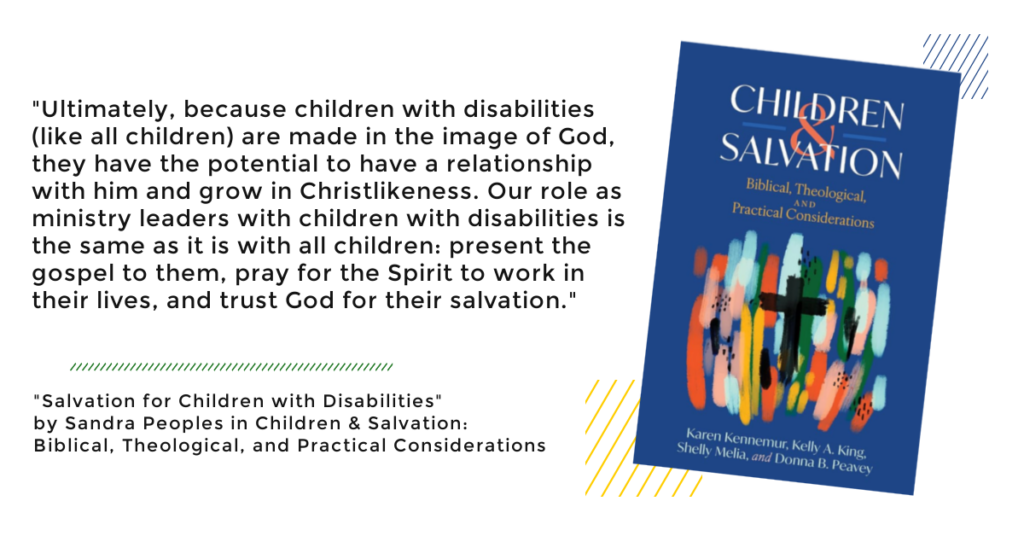
You can get a copy of the book, Children and Salvation to learn more about all these topics. It’s available on Amazon or at Lifeway.com.